My teaching philosophy
Active learning
Section titled “Active learning”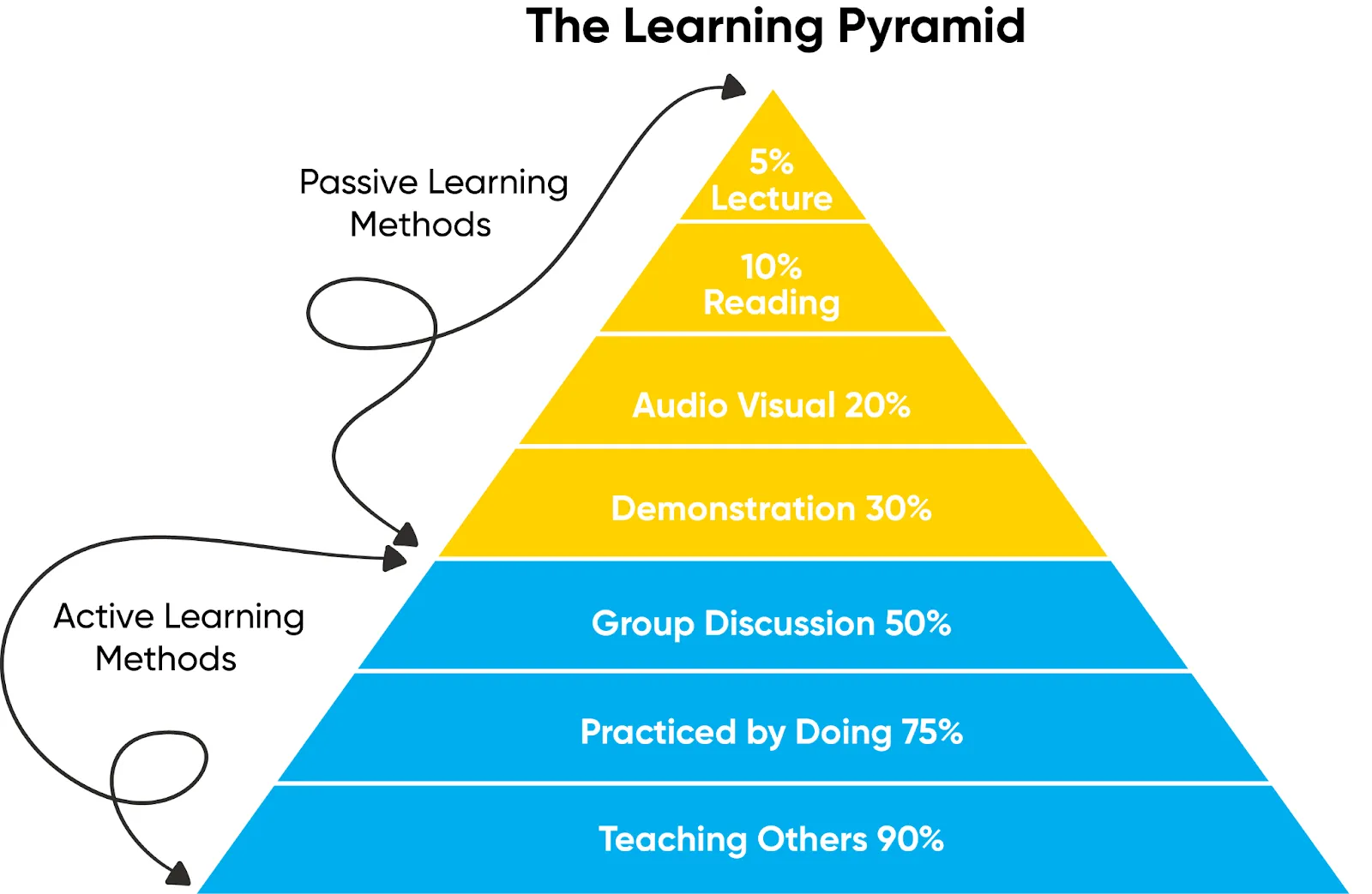
My teaching philosophy is centered on active learning strategies. That is while we require lectures, reading, and demonstrations to introduce new concepts, we do not begin to internalize the material until we actively engage in discussions, hands-on practice, and teaching others.
Doing the opposite of the passive learning acitivies will improve your retention and understanding of the material significantly. The opposite of listening to lectures is to engage in discussions and to explain concepts to others. The opposite of reading is to take notes, summarize, and create mind maps. The opposite of watching demonstrations is to do hands-on practice and experiments.
Keep a learning log
Section titled “Keep a learning log”I encourage you to keep a learning log or journal. Depending on your preference, this could be a physical notebook, an online blog, a Google Doc, or a dedicated app like Notion or Obsidian. The key is to regularly document what you are learning, your thoughts, questions, and reflections. Most importantly, when you encounter issues document how you resolved them.
You can also write public posts on LinkedIn or in the DEV community to share your learning journey with others. This not only helps reinforce your understanding but also allows you to connect with like-minded individuals who can provide support and feedback.
Learn by doing
Section titled “Learn by doing”Learning photography
Section titled “Learning photography”There’s a famous study about learning photography that illustrates the importance of active engagement.
A univeristy professor divided his photography class into two groups.
One group was the Quantity group. They were graded based on the number of photos they took throughout the semester. To get an A grade, they had to take at least 100 photos. This group spent their time going out and taking pictures, experimenting with different techniques, and learning from their mistakes.
The other group was the Quality group. They only needed to produce one high quality photo, but in order to get an A grade photograph had to be outstanding. They spent their time discussing composition, lighting, and technical details, aiming for perfection in that one shot.
At the end of the semester, the Quantity group produced the best photos. This is because they were actively engaged in taking photos, experimenting with techniques, and learning from their mistakes. In contrast, the quality group spent their time speculating about perfection without much practical experience.
Learning to cooking
Section titled “Learning to cooking”There are two students who want to learn to cook. One student reads cookbooks and watches cooking shows, while the other student spends time in the kitchen experimenting with recipes, techniques, and getting feedback from peers. Which student do you think is likely to get better at cooking?
The student who spends time in the kitchen experimenting with recipes and techniques is likely to become a better cook. While reading cookbooks and watching cooking shows can provide valuable knowledge, it is the hands-on experience that truly solidifies learning. By actively engaging in the cooking process, the student learns to adapt recipes, understand flavors, and develop their own style. This experiential learning allows for deeper understanding and retention of skills compared to passive observation.
Learn by teaching others
Section titled “Learn by teaching others”As the saying goes, the best way to learn something is to teach it.
Imagine you have been tasked to teach these concepts at a workshop at your workplace or college.
Notice how you no longer see yourself as a passive learner, but an active teacher. You will naturally start to think about how to explain concepts clearly, anticipate questions, and find relatable examples. This shift in perspective deepens your understanding and retention of the material. This allows you to move from passive learning to active learning.
Nominate someone to teach
Section titled “Nominate someone to teach”I want you to identify someone you can teach what you are learning. This could be a friend, family member, or colleague. It does not matter if they are technical, in fact, it’s actually better if they are not because it forces you to simplify concepts and explain them clearly.